
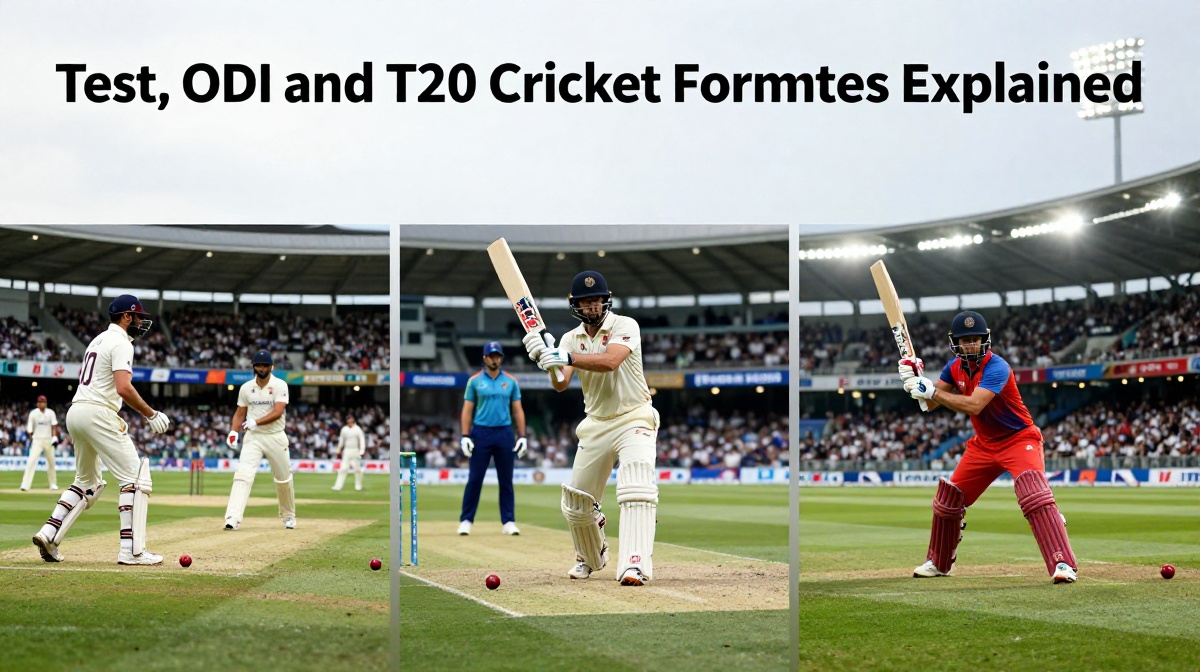
Test, ODI and T20 Cricket Formats Explained

If you have ever watched a Test match drag on for five days and then switched to a T20 where 20 overs were done in three hours, you already know these formats feel completely different. But most fans don’t know the exact rules that make each format tick, or why those rules exist. This guide breaks it all down in plain language.
What Are the Three Main Formats of Cricket?
The International Cricket Council ICC officially recognises three international formats Test cricket, One Day Internationals ODIs, and Twenty20 Internationals T20Is. Each format has its own set of rules, its own rhythm, and its own kind of fan following.
India plays all three with serious intensity. Think of the Border-Gavaskar Trophy in Tests, the 50-over World Cup in ODIs, and the ICC T20 World Cup where India finally lifted the trophy in 2024. Even if you follow cricket casually on JioCinema, knowing the differences helps you understand why a team makes certain decisions at different points in a match.
Test Cricket
How It Works
Test cricket is the oldest format. The first-ever Test match was played between Australia and England in Melbourne from March 15 to 19, 1877. Australia won by 45 runs. It has been going strong for nearly 150 years.
Each team bats twice, and there is no fixed over limit per innings. A full day of Test cricket normally has 90 overs scheduled. A match can last up to five days, though it often ends earlier. To win, a team needs to bowl out the opposition twice and score more runs. If neither side can do that in five days, the match is a draw.
There is no coloured clothing. Both teams wear whites. The ball is red, though day-night Tests use a pink ball. This matters because a red ball swings and seams more as it gets older, which is central to the tactics in Test cricket.
Strategy in Tests
Patience is the heart of Test cricket. A batsman might spend an entire day scoring 80 or 90 runs, building an innings slowly. A bowling side might set a field to suffocate runs rather than take wickets immediately.
This format truly tests a player’s technique. A loose shot in T20 might cost one wicket. In Test cricket, one mistake can cost the match. India’s Cheteshwar Pujara, for example, became famous for grinding out long innings at Eden Gardens and other Indian venues, frustrating opposition bowlers for hours.
2025 Rule Update for Tests
In June 2025, the ICC introduced a stop clock in Test cricket. Under this rule, the fielding team must be ready to start the next over within 60 seconds of the previous one ending. Umpires give two warnings and then award five penalty runs for each further delay. This was introduced because slow over-rates in Tests had become a long-standing problem. The clock resets every 80 overs.
ODI Cricket
How It Works
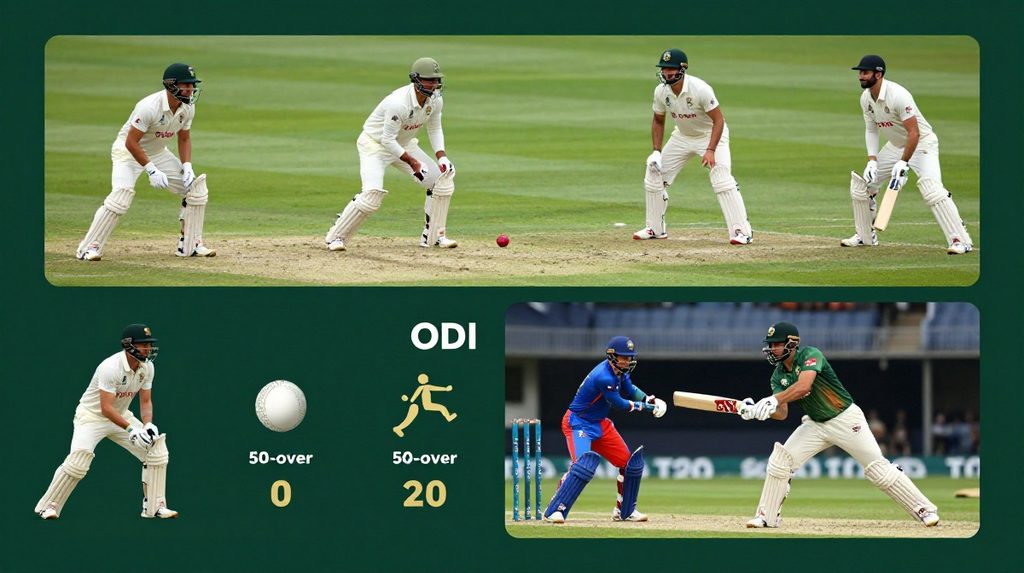
The first ODI was played between England and Australia on January 5, 1971. It came about almost by accident when a Test match was washed out and both teams agreed to play a one-day game of 40 eight-ball overs per side. The format has since settled at 50 overs per side.
In an ODI, each team bats once for up to 50 overs. Each bowler can bowl a maximum of 10 overs. The ball is white, and players wear coloured jerseys. Fielding restrictions called powerplays are in place at different stages of the innings. In the first 10 overs, only two fielders are allowed outside the 30-yard circle.
ODIs are generally completed in about eight hours, often played across a full day.
Strategy in ODIs
An ODI innings has three distinct phases the powerplay, the middle overs, and the death overs. A team that scores 60 to 70 runs in the first 10 overs has a solid base. The middle overs 11 to 40 are about building partnerships and rotating the strike. The last 10 overs are for aggressive hitting.
For Indian fans, the 50-over World Cup is the biggest event in this format. India won it in 1983 and 2011. The 2011 final at Wankhede Stadium in Mumbai, where MS Dhoni hit that iconic six, was an ODI.
2025 Rule Update for ODIs
From July 2025, the ICC brought back the single-ball rule for the second half of ODI innings. For the first 34 overs, two new balls are used one from each end. Before over 35 starts, the fielding team picks one of the two balls to use for overs 35 to 50. This decision was made to bring back reverse swing in the later overs, which had largely disappeared when two balls were in use. If you follow cricket closely, you will know that reverse swing can completely change the balance of a late-innings chase. The ICC’s Men’s Cricket Committee, chaired by Sourav Ganguly, recommended this change.
The lotus365 app and other cricket-focused platforms have already started displaying ball-change updates as live match events for ODIs, reflecting how significant this rule shift is for match dynamics.
T20 Cricket
How It Works
The first official T20 International was played on February 17, 2005 between New Zealand and Australia in Auckland. The format took off after India’s surprise win at the inaugural ICC T20 World Cup in 2007 in Johannesburg. That win led directly to the creation of the IPL in 2008, which is now the richest domestic cricket league in the world.
Each team gets 20 overs. Each bowler can bowl a maximum of 4 overs. The match is typically done in about three hours, making it ideal for evening viewing. The powerplay lasts for the first 6 overs, with only two fielders allowed outside the 30-yard circle.
Strategy in T20s
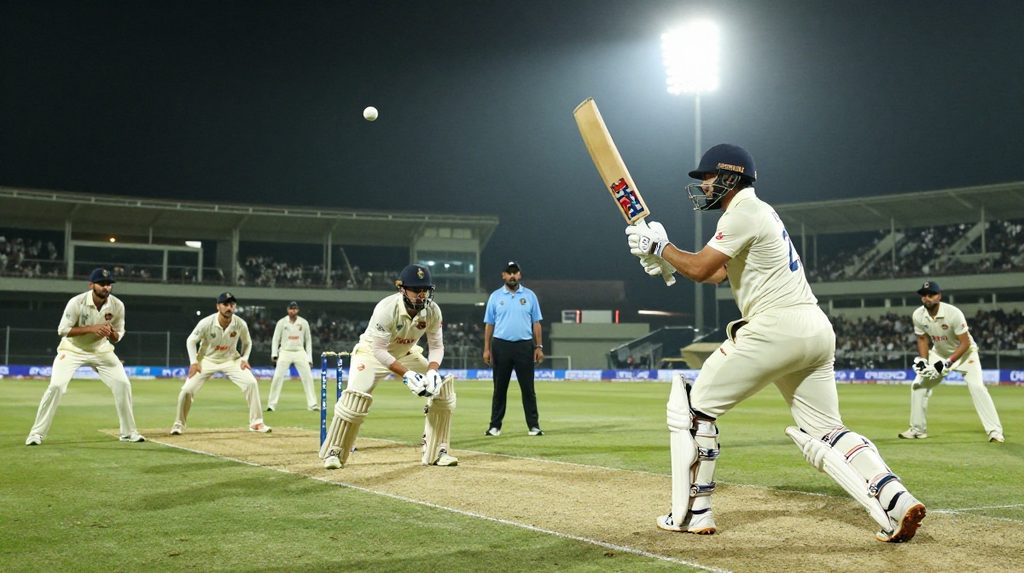
T20 is high-risk, high-reward cricket. There is almost no time to rebuild after losing wickets early. A team that loses two wickets in the first four overs is in immediate trouble. Batsmen target specific bowlers, use ramp shots, switch-hits, and scoops that you rarely see in the other formats.
Bowlers have to be clever. A T20 bowler’s economy rate runs given per over matters more than wickets in many situations. Yorkers, slower balls, and well-disguised variations are the tools of the trade.
For Indian fans, the IPL is the biggest showcase of T20 cricket. Teams like Chennai Super Kings, Mumbai Indians, and Royal Challengers Bengaluru have made T20 cricket a year-round conversation in India.
2025 Rule Update for T20s
From July 10, 2025, the ICC changed how powerplay overs are calculated in matches that are reduced due to rain or other interruptions. Earlier, powerplay overs in shortened games were rounded to the nearest full over. Now, the ICC rounds to the nearest ball, so powerplay overs remain close to 30% of the total innings length. For example, in a 10-over game, the powerplay is exactly 3 overs. This rule had already been in use in England’s T20 Blast for several years before the ICC adopted it globally.
If you use a lotus365 apk to follow live match odds and updates, you may notice how quickly betting lines shift during and just after the T20 powerplay, which shows how much those six overs matter.
Important note: Betting on cricket is governed by state laws in India. Online betting exists in a legal grey area in most Indian states. Always check local regulations before participating, and never bet more than you can afford to lose.
Test vs ODI vs T20: A Quick Comparison
| Feature | Test | ODI | T20 |
|---|---|---|---|
| Duration | Up to 5 days | ~8 hours 1 day | ~3 hours |
| Overs per innings | No limit 90/day | 50 | 20 |
| Innings per team | 2 | 1 | 1 |
| Max overs per bowler | No limit | 10 | 4 |
| Ball colour | Red pink for D/N | White | White |
| Powerplay overs | None | 10 overs mandatory | 6 overs |
| Result possible | Win, loss, or draw | Win, loss, tie, no result | Win, loss, tie, Super Over |
| First played | 1877 | 1971 | 2005 |
Which Format Demands What from Players?
Test cricket demands technique and endurance. A batsman needs to handle swing, seam, and spin across multiple sessions. A fast bowler may have to bowl 25 to 30 overs in an innings, often on day four or five when the pitch has cracked.
ODI cricket needs a player who can shift gears. You might bat cautiously for 15 overs and then hit boundaries in the last 10. An ODI all-rounder like Hardik Pandya needs to chip in with both bat and ball.
T20 cricket rewards explosive skills. A player who can hit sixes off good deliveries, or bowl an accurate yorker under pressure, is worth a lot. The IPL auction prices often running into crores of rupees reflect exactly which skills are valued in this format.